Substitution rules in Fantasy Premier League: how do auto-subs work in FPL?
Everything you want to know about transfers in Fantasy Premier League

Many Fantasy Premier League players have never fully figured out how substitutions work in this football game. To be honest, we also sometimes ask questions like “Will my defender come in instead of the midfielder who didn’t play this round?” To answer such questions we have prepared this material for you. So, everything about substitutions in Fantasy Premier League – let’s figure it out together.
We work in a “question - answer” format.
What are substitutions in Fantasy Premier League?
In Fantasy Premier League (FPL) there are two main squad management mechanisms. The first — manual changes that the manager makes himself before a gameweek: for example, swapping players in the “starting 11” or rearranging substitutes. The second — automatic substitutions, or auto-subs, which the system calculates after the gameweek matches have finished.
Automatic substitutions help preserve points using players from your bench if someone from the starting lineup did not take part in the matches.
When do automatic substitutions occur in FPL?
An automatic substitution is triggered if a player from the starting lineup did not get onto the pitch during the gameweek. After the matches finish, the system checks the squad and, if necessary, adds one of the available substitutes in place of the missing player.
The order of players on the bench and the allowed team formation are taken into account. Therefore, simply having a substitute does not guarantee that he will end up in the final lineup.
In what order do substitutes come in in FPL?
Priority is determined by the placement of players on the bench. The player you put in the first spot gets precedence over the other outfield substitutes.
If the first candidate cannot be used due to squad restrictions, the system considers the next player. The check continues until a suitable option is found or there are no remaining candidates.
Thus, the arrangement of players on the bench has practical significance: it affects who gets the chance to bring additional points to your team.
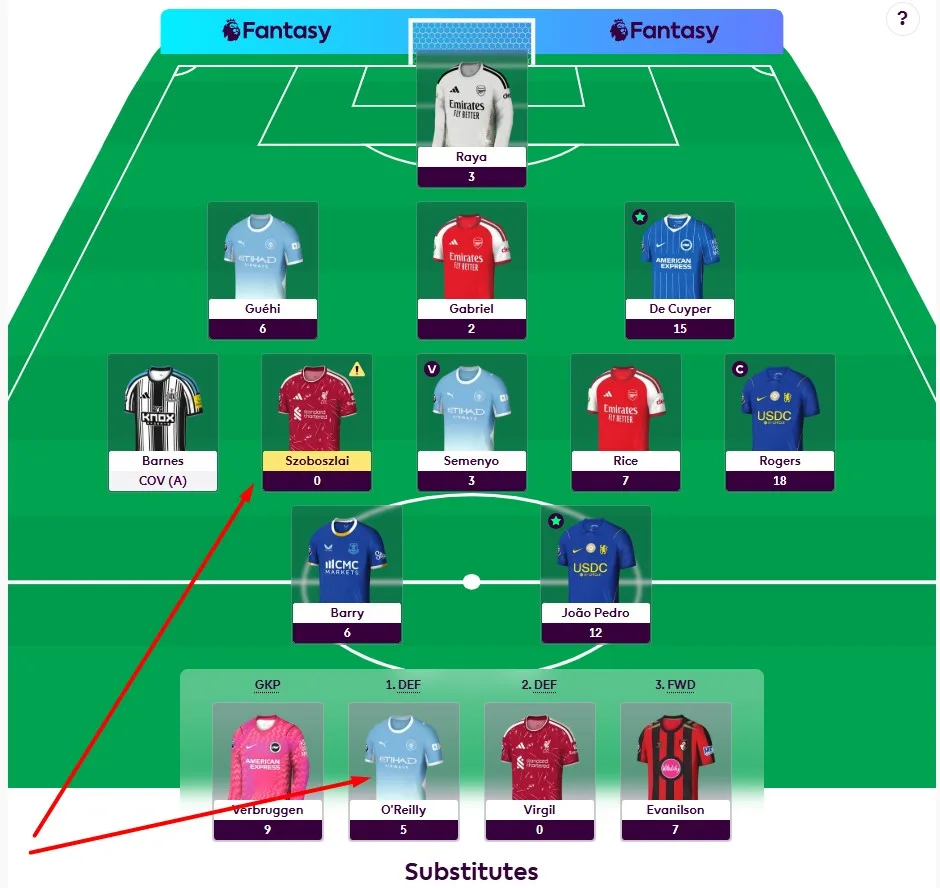
Let's look at a real example. Here is a situation where Liverpool midfielder Dominik Szoboszlai did not play in the gameweek due to an injury sustained right before the match. In the Fantasy substitution list, the goalkeeper is first, but he does not meet the rules, so Szoboszlai will replace the next player on the “bench” – nominal defender Nico O'Reilly, who will bring points to his Fantasy manager.
Can a substitute goalkeeper replace an outfield player or vice versa?
No. A separate rule applies to goalkeepers: if the main goalkeeper did not participate in the gameweek, he can only be replaced by a backup goalkeeper who himself played in the corresponding gameweek.
Outfield players cannot take the goalkeeper's spot, even if they came onto the pitch for their real clubs and earned points. Similarly, a backup goalkeeper does not replace a defender, midfielder, or forward.
What tactical formation restrictions apply to auto substitutions in FPL?
Automatic substitutions must maintain a permissible team layout. After the gameweek ends, the squad must still contain at least one goalkeeper, three defenders, two midfielders, and one forward.
This means the system does not always use the highest‑priority substitute. If his inclusion would breach the minimum requirements for any line, the algorithm will skip that candidate and consider the next available outfield player.
For example, if the starting lineup had only three defenders and one of them did not play, the system cannot field a forward in his place, because the team would be left with only two defenders. In such a situation it will consider another substitute whose inclusion would preserve a legal formation.
What tactical formations are allowed in Fantasy Premier League?
In FPL you can use various combinations of defenders, midfielders, and forwards, provided they meet the game's minimum requirements. For example, permissible options include the 3-5-2, 4-4-2, 5-3-2, and 3-4-3 formations.
Automatic substitutions must not violate these constraints. Therefore, the correct placement of substitutes can be especially important if one or more base players miss a gameweek.
Is a player considered to have played if he came onto the field at the end of a match?
Yes. If a player appears on the field even for a short period, including in compensated minutes of the second half, he is considered to have participated in the match. In that case, an automatic substitution for him is not made, even if the player was on the field for only a few seconds.
Therefore, when assessing the likelihood of an auto substitution, it is important to consider not only whether the player was in the starting lineup but also the possibility of his appearance from the bench in the real match.
What happens if a player receives a card without coming onto the field?
According to the rules published on the Premier League website, a player who receives a yellow or red card while on the bench of his real club may be considered to have participated in the gameweek for the purposes of automatic substitutions. This exception is important to take into account when calculating the final squad.
Since such situations depend on the official interpretation of FPL rules, it is always necessary to check the current conditions for the relevant season.
What will happen if a base player spends the entire match on his club's bench?
If a player does not appear on the field and does not fall under the rule's exception, he is considered not to have played in the gameweek. In that case, the system can replace him with an available player from your “fantasy bench”.
However, the outcome depends on the substitute priority and tactical formation constraints. If there are no suitable candidates, the spot of the absent player may remain unfilled.
What happens if the FPL team captain does not play in the gameweek?
If the selected captain does not take part in any match of the gameweek, the captaincy automatically passes to the vice‑captain. The vice‑captain’s points for that gameweek are doubled.
For this to happen, the vice‑captain must have participated in the gameweek and his designation must remain valid. If both players do not play, the transfer of captaincy will not yield additional doubled points.
Can the vice‑captain receive the captain's bonus if the captain played only one minute?
No. If the captain appears on the field for at least one minute during a gameweek, the automatic transfer of the captain's armband does not occur. In this case the vice-captain's points doubling does not apply, even if the captain spent very little time on the field.
This rule is important to consider when choosing a captain, especially if there are doubts about his readiness for the match or the likelihood of being substituted.
How do automatic captain swaps work in a Double Gameweek?
In a Double Gameweek a player can play two matches within a single gameweek. If the captain played in at least one of them, even appearing on the field for only a few minutes, the condition for automatic captaincy transfer is not met.
If the captain did not take part in either of the two matches, the captain's bonus passes to the vice-captain in accordance with the relevant FPL rules. Therefore, when selecting a captain for a Double Gameweek, you should consider not only the potential points total but also the likelihood of his appearing on the field in at least one match.