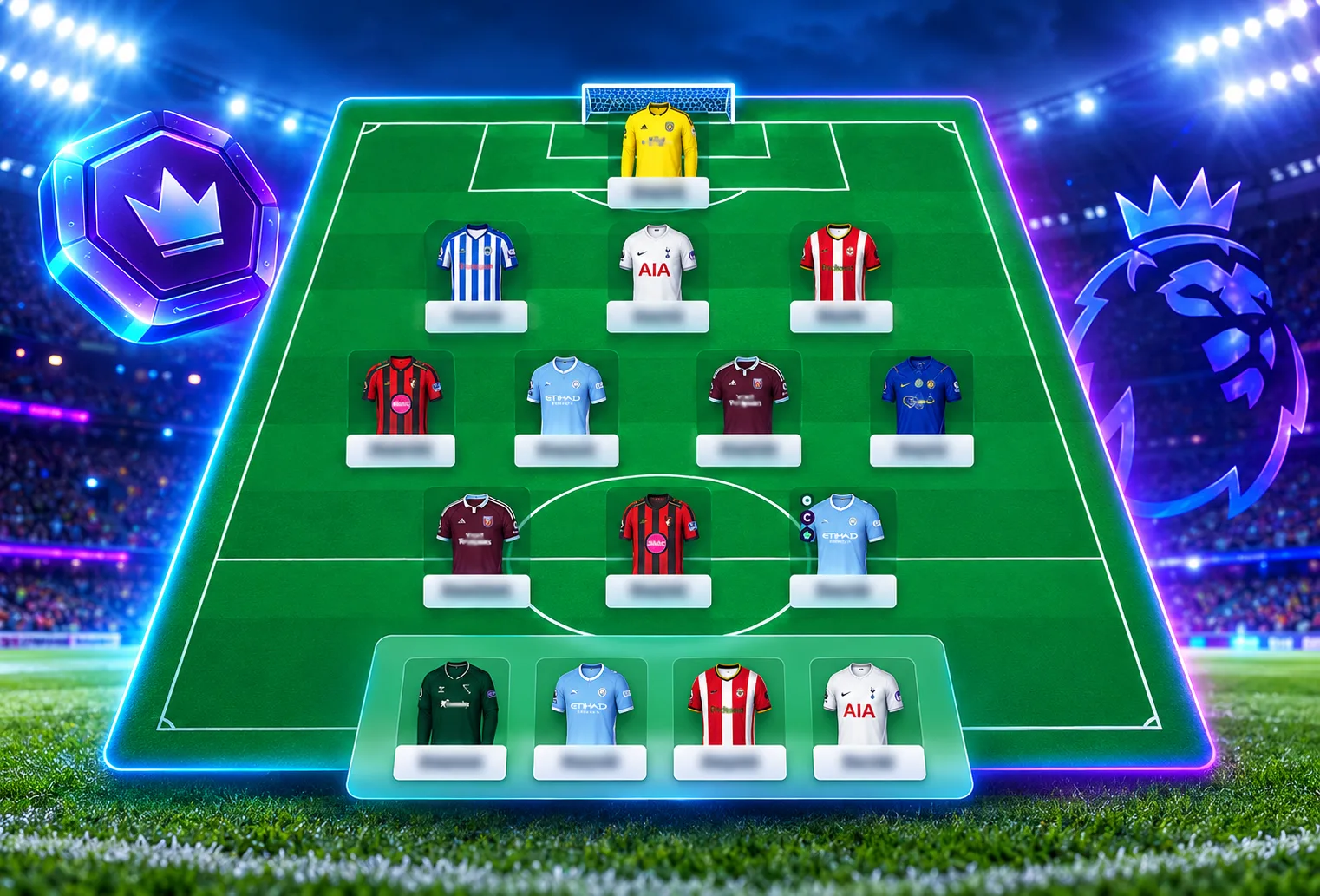
Wildcard in Fantasy Premier League: what it is and perfect time to use it?
What is a Wildcard in FPL and when is it best to activate this chip?

Wildcard — one of the most important and useful chips in Fantasy Premier League (FPL). It allows you to completely revamp your team by making an unlimited number of transfers without losing points for additional moves. This is especially relevant in situations where several players have suffered injuries, lost their place in the starting lineup, or stopped delivering expected results.
However, Wildcard is not just an opportunity to replace poorly chosen players. When used wisely, this chip helps you prepare for a favorable schedule, take advantage of changes in Premier League club line‑ups, increase your team's value, and lay the groundwork for a successful performance in the second half of the season.
In Fantasy Premier League, each manager receives two Wildcards per season. The first is intended for the first half of the championship, the second—for the final part of the campaign. Let’s explore how these chips work, when it’s best to activate them, and which mistakes to avoid when completely revamping your team.
What is a Wildcard in FPL?
Wildcard is a special chip that allows an unlimited number of free transfers within a single game week (Gameweek). When activated, the manager can replace almost the entire squad without receiving the standard 4‑point penalty for each additional transfer.
Unlike regular transfers, whose number is limited by the accumulated pool of free moves, Wildcard allows you to change players without restriction until the deadline of the respective game week.
The main feature of this chip is that squad changes are retained even after the Gameweek ends. In other words, Wildcard allows you not just to temporarily alter the team, but to fully refresh it for the long term.
This distinguishes it from another popular chip — Free Hit. When using Free Hit, changes apply only for a single game week, after which the team reverts to its previous lineup. Wildcard, however, retains all confirmed changes.
How many Wildcards can be used per season?
In the 2026/27 season, each manager receives two Wildcards. They are divided into two parts of the championship and cannot be carried over from one period to another.
Chip | Usage Period | Features |
|---|---|---|
First Wildcard | After the first game week and until the GW19 deadline. | Intended for revamping the team in the first half of the season. |
Second Wildcard | After the GW19 deadline and until the end of the season. | Allows you to prepare the squad for the decisive part of the championship. |
In the 2026/27 season, the first Wildcard must be used before the deadline of the 19th game week, which is set for January 2, 2027, 13:30 GMT. If you do not activate the chip by that time, it will expire. It cannot be transferred to the second half of the championship.
The second Wildcard becomes available after the usage period of the first set of chips ends and can be applied up to the end of the season.
Note: Wildcard cannot be used in the first game week. It becomes available after GW1 ends.
When is it best to use a Wildcard?
There is no universal gameweek in which every manager must activate a Wildcard. The optimal timing depends on the team's condition, the results of previous gameweeks, the transfer market, and the schedule of upcoming matches.
Nevertheless, several situations can be identified where using this chip is especially justified.
1. Early team overhaul — GW6–GW9
Early gameweeks provide information that cannot be had when forming the starting lineup. Gradually it becomes clear which teams are truly well‑prepared for the season, which Premier League newcomers have quickly adapted to the competition, and which players have been given more important roles than expected.
That is why the interval between the sixth and ninth gameweeks is often seen as an appropriate moment for the first Wildcard.
By this time you can assess:
The actual form of teams and individual players.
Changes in starting lineups and the distribution of playing time.
New takers of penalties, corners, and free kicks.
The productivity of forwards and attacking midfielders.
The upcoming schedule of clubs for the next several gameweeks.
Another advantage of an early Wildcard is related to changes in player prices. If a cheap player starts consistently scoring points, his price may gradually rise. Acquiring such a player before a significant price increase can sometimes provide an extra gain in team value.
However, you shouldn't activate the chip just because the sixth or eighth gameweek has arrived. If the starting lineup continues to deliver good results, it's better to keep the Wildcard for a more suitable moment.
2. A high number of injuries and a poor run
Another obvious reason to use a Wildcard is serious squad issues. Sometimes several key players suffer injuries, lose their place in the starting eleven, or stop playing regularly.
One or two poor choices can usually be corrected with ordinary transfers. But if three or four problematic players have accumulated and a tough schedule lies ahead, gradual player replacement may not be the most effective solution.
The Wildcard allows you to get rid of several poor signings at once and build a more competitive squad.
It is important not to confuse temporary difficulties with the need for a complete team overhaul. For example, the absence of a player due to a short‑term injury is not always a sufficient reason to activate the chip. Before deciding, you should review medical news, players' return forecasts, and possible changes in starting lineups.
3. Preparing for Double Gameweeks
Double Gameweek (DGW) is a gameweek in which some teams play two matches instead of one. In such situations, the players of the relevant clubs get extra opportunities to earn points.
For example, if a striker normally plays one match per gameweek, in a Double Gameweek he has the chance to play twice. A similar situation applies to midfielders and defenders, who can earn extra points for goals, assists, clean sheets, and other actions.
The Wildcard can be a useful tool for preparing for such gameweeks. The manager gets the chance to assemble a squad in advance with many players who are set to play two matches.
However, it is important to consider several factors here:
Not all teams will necessarily have a double gameweek.
An extra match does not guarantee a high scoring output from a player.
Possible rotation may reduce the playing time of individual players.
After a Double Gameweek, some teams may face a tough run of fixtures.
Therefore, you shouldn't build the whole team solely for a single double gameweek. It's much wiser to choose players who will remain attractive even after it ends.
4. Preparing for Blank Gameweeks
Blank Gameweek (BGW) is the opposite of Double Gameweek. In such a round, some teams do not have matches, and consequently their players do not earn points for played fixtures.
The reasons for the appearance of Blank Gameweeks are usually related to match postponements, cup competitions, and the specifics of the English football calendar.
Wildcard allows you to get rid of players from teams that will not participate in a particular gameweek in advance, and replace them with players who have a full schedule.
At the same time, you need to consider that for preparing for an individual Blank Gameweek, Free Hit is sometimes more suitable. This chip allows you to temporarily change the entire squad for just one round, without giving up long‑term acquisitions. Wildcard makes sense to use if the changes will be useful not only in the specific gameweek but also in the future.
5. Changes to the calendar and the emergence of new promising players
Sometimes the need for a complete team overhaul arises not because of injuries or poor results, but due to changing circumstances in the Premier League.
For example, a manager may change the tactical system, a player may get a new position on the pitch, and a previously unused player may secure a place in the starting lineup. As a result, new promising options for FPL appear.
If the calendars of several teams change simultaneously, Wildcard can help quickly take advantage of new opportunities and assemble a squad with more attractive prospects for the upcoming gameweeks.
How to correctly build a team with a Wildcard?
Activating a Wildcard gives the manager greater freedom of action, but it does not cancel the core rules of Fantasy Premier League. When forming a new squad, you need to consider the budget, the limit of players from a single club, playing time, the calendar, and point‑scoring prospects.
1. Distribute the budget correctly
A budget of £100.0 million is allocated for building a starting team in FPL. However, when using a Wildcard you need to focus on the current available budget, which consists of the funds in the bank and the team’s value, taking into account the player sale rules.
You shouldn't spend almost all the money on a few expensive stars, leaving the other positions without quality performers. Such a structure can become overly dependent on two or three players and make the team vulnerable to injuries or rotation.

Instead, it's better to find a balance between expensive players with high point‑scoring potential, mid‑price footballers and cheap squad members.
Special attention should be given to the so‑called enablers — budget footballers who free up funds for acquiring more expensive players. However, a cheap player should have at least some prospect of playing time. A bench player who never plays can save budget but will hardly bring any benefit over the season.
2. Observe the limit on the number of players from a single club
Fantasy Premier League rules prohibit including more than three footballers from the same English Premier League club in one team.
This restriction applies to all 15 spots in the squad, including bench players. Therefore, when using a Wildcard you should check in advance how many representatives of each club are in your team.
It is especially important to keep this in mind when building a squad around league leaders. If you have already bought three players from one club, you cannot add a fourth representative of that team.
3. Analyze the calendar several gameweeks ahead
One of the most common mistakes when using a Wildcard is focusing too much on the upcoming gameweek. A manager may assemble a squad of players who have favorable fixtures right now, but in a week or two their prospects may be significantly worse.
To avoid such situations, you need to study the calendar at least five to six gameweeks ahead.
For this you can use the Fixture Difficulty Rating (FDR) — a special assessment of upcoming match difficulty, available on the official Fantasy Premier League website.
FDR helps compare the schedules of different teams and find clubs that have a series of relatively easy fixtures. This is especially useful when selecting defenders and attacking players.
Nevertheless, FDR should not be taken as an absolute metric. Match difficulty depends on the current form of opponents, home and away conditions, injuries and other factors that can change by the time the fixture takes place.
4. Monitor changes in player prices
During a Wildcard, a manager can buy and sell players without penalties for additional transfers. Therefore, it's important to pay attention to the price dynamics of players.
If you plan to include a player who is in high demand and may become more expensive, it sometimes makes sense to buy him earlier. Similarly, you can monitor players who are losing popularity and may become cheaper.
However, you shouldn't turn the use of a Wildcard into a pure price‑chasing exercise. The main goal is to build the most promising squad, not to earn a few extra hundred thousand by price fluctuations.
5. Choose players with high point‑scoring potential
The core of the team should consist of players who can regularly bring points. When selecting attacking players, it is useful to look at expected goals (xG) and expected assists (xA), the number of shots, created chances and involvement in dangerous attacks.
For defenders, not only the point‑scoring potential in clean‑sheet matches matters, but also involvement in attacking actions: crosses, key passes, shots and participation in set‑pieces.
Special attention should be given to penalty, corner and free‑kick takers. This role can create extra opportunities for scoring actions and increase a player's appeal in FPL.
At the same time, you shouldn't select players solely based on past points. It's much more useful to assess how consistent their performances are and whether there is reason to expect a continuation of a scoring run.
6. Don't forget a strong bench
When using the Wildcard, some managers try to minimize spending on bench players. In certain situations this is justified, but completely ignoring squad depth is not advisable.
During the season, injuries, suspensions and rotation can affect almost any player. Therefore it is advisable to have at least one or two bench players who regularly get onto the pitch and can replace absent footballers.
This is especially important during congested periods of the calendar, when clubs play several matches in a short time.
Wildcard and changes in player prices: how to gain extra benefit?
One of the advantages of the Wildcard is the ability to actively manage the squad before the deadline, without fearing penalties for the number of transfers.
During the season, player values in FPL change depending on managers' activity in the transfer market. Players that are bought en masse can rise in price, while those that are actively sold can fall.
Therefore, when using the Wildcard, you can consider not only point‑scoring prospects but also possible changes in the team's value.
For example, if you plan to acquire several players whose popularity is rapidly rising, you might consider making the transfers earlier. This will help avoid a potential increase in their price.
But there is an important nuance: an increase in a player's price does not mean that the entire gain automatically becomes available to the manager upon selling him. FPL has separate rules for calculating profit from player price increases. Therefore, one should not overestimate the potential financial effect of such moves.
What mistakes should be avoided when using the Wildcard?
Even an unlimited number of free transfers does not guarantee a successful outcome. When overhauling the team, it is important not to give in to emotions and not to make changes solely for the sake of using the chip.
Here are the most common mistakes:
Using the Wildcard without a real necessity. If your team regularly scores points and has no serious issues, it's better to keep the chip.
Focusing only on a single game week. You shouldn't pick players solely for one convenient match, forgetting the subsequent schedule.
Chasing past results. A player who has scored many points in recent weeks is not necessarily going to continue performing at the same level.
An overly expensive core. An unbalanced squad with several stars and a weak bench can cause problems when the first injuries occur.
Ignoring playing time. Even a promising player won't be useful if he doesn't regularly get onto the pitch.
Forgotten first Wildcard deadline. An unused chip from the first half of the season expires and does not carry over to the second.
Wildcard or Free Hit: which chip to choose?
Wildcard and Free Hit allow unlimited free transfers, but their purpose differs significantly. The right choice between these chips is especially important when preparing for Double and Blank Gameweeks.
Characteristic | Wildcard | Free Hit |
|---|---|---|
Number of transfers | Unlimited | Unlimited |
Penalty for additional transfers | No | No |
Duration of effect | Ongoing squad changes | Only one gameweek |
Return of the previous lineup | No | Yes, after the round ends |
Primary purpose | Long-term team restructuring | Temporary adaptation for a specific round |
If you want to completely change the squad and keep new acquisitions for several upcoming gameweeks, choose Wildcard. If you need to temporarily set the team for a specific Blank or Double Gameweek, after which you plan to return to the previous squad, Free Hit may be a more suitable solution.
Conclusion: when is it best to activate the Wildcard in FPL?
Wildcard — one of the most powerful tools in a Fantasy Premier League manager's arsenal. It allows you to correct mistakes when forming the squad, get rid of injured and out‑of‑position players, take advantage of calendar changes and prepare the team for the most important gameweeks.
There is no single correct moment to activate this chip. For some managers the optimal solution will be to rebuild the team already in GW6–GW9, for others it will be better to wait for serious squad problems or a more convenient schedule in the second half of the season.
The main thing is not to rush to use the Wildcard just because you have the opportunity to replace several players for free. Before activation you need to assess the team's condition, the outlook for the upcoming gameweeks, and the benefit the new acquisitions can bring in the long term.
Main rule: a good Wildcard is not just 15 new players, but a balanced team that can consistently score points over several upcoming gameweeks.
Frequently Asked Questions about the Wildcard in FPL
How many times can you use a Wildcard per season?
In the 2026/27 season each manager receives two Wildcards. The first is available after the first gameweek and until the GW19 deadline, the second — after that period ends and until the end of the season.
When does the first Wildcard expire in the 2026/27 season?
The first Wildcard must be used before the GW19 deadline, set for 2 January 2027, 13:30 GMT. An unused chip expires and does not carry over to the second half of the season.
Can you use a Wildcard in the first gameweek?
No. The first Wildcard becomes available only after GW1 is completed.
How many free transfers does a Wildcard give?
The number of transfers is unlimited. The manager can change the squad as many times as desired before the deadline of the respective game week without penalties for additional moves.
Does the squad stay after using a Wildcard?
Yes. Unlike Free Hit, changes after activating a Wildcard are retained for subsequent game weeks. There is no return to the original squad.
Can you use the Wildcard together with another chip?
No. In a single gameweek you can activate only one chip. For example, you cannot use the Wildcard and Bench Boost at the same time.
Do accumulated free transfers remain after a Wildcard?
Yes. If you have unused free transfers accumulated before activating the chip, they carry over to the next gameweek.
Can you use the Wildcard to prepare for a Double Gameweek?
Yes. The Wildcard allows you to set up a squad in advance with several players who are scheduled to play two matches in one gameweek. However, you need to consider the subsequent schedule so that the acquisitions remain useful after the Double Gameweek ends.
Can the Wildcard be cancelled after activation?
Once the Wildcard is fully confirmed and activated, it cannot be cancelled. Therefore, before confirming transfers, you should carefully check all squad changes.
Read also: Differentials in Fantasy EPL: what they are and how to use low‑ownership players